
Stenotype layout: Difference between revisions
(→Key and chord placement: links to English phonotactics for people that want to see more indepth reasoning behind the steno order) |
m (Sammi Ta moved page Ward Stone Ireland layout to Stenotype layout: Switching to the canonical name for the layout) |
||
| (2 intermediate revisions by 2 users not shown) | |||
| Line 1: | Line 1: | ||
The Ward Stone Ireland | {{incomplete}} | ||
The '''Stenotype''' layout (also known as the '''Ireland''' or '''WSI''' layout) is an English-language steno layout, first developed by Ward Stone Ireland and patented in 1911. The first machines bearing this layout were produced by Ireland's Universal Stenotype Company<ref>Stenograph LLC. ''[https://www.stenograph.com/history-writers The History of Writing Machines]''.</ref>, and it is now the predominant steno layout for the English language, and has also been adapted to [[Steno layouts and supported languages|other languages]]. Its [[steno order]] is: | |||
<code>STKPWHRAO*EUFRPBLGTSDZ</code> | <code>STKPWHRAO*EUFRPBLGTSDZ</code> | ||
| Line 6: | Line 8: | ||
== History == | == History == | ||
Patents were first issued to Ireland in 1911 for a "type-writing machine"<ref>Ireland, W.S. (1911). ''Type-writing machine'' ([https://docs.google.com/viewer?url=patentimages.storage.googleapis.com/pdfs/US980274.pdf U.S. Patent No. 980,274]).</ref> containing 19 keys and a number bar; and in 1913 for a steno theory<ref>Ireland, W.S. (1913). ''Stenographic writing means''. ([https://docs.google.com/viewer?url=patentimages.storage.googleapis.com/pdfs/US1057964.pdf U.S. Patent No. 1,057,964]).</ref> using that layout. Later versions of this layout added one or two keys in the middle, now the asterisk key, and a fifth column on the right-hand side for the -D and -Z (originally a second -S, referred to as "-S under -D") keys. | |||
The first theory for this layout was published in the book ''[https://archive.org/details/stenotypy00indi Stenotypy]'' in 1914; most mainstream English steno theories are ultimately derived from this theory and continue to use many chords and rules from it. | |||
== Chords == | == Chords == | ||
== Key and chord placement == | == Key and chord placement == | ||
The | The Stenotype layout is designed such that its steno order allows for chords that follow [[wikipedia:English_phonology#Phonotactics|English phonotactics]] (allowable sound sequences within English syllables). On their own, each key represents the sound it is labeled with. To write the word "hot", one would press <code>HOT</code>. Keys can be combined into chords to make up for the missing sounds not on the layout (e.g. "shot" is written as <code>SHOT</code>). The WSI layout allows for many of these simple combinations that match their spellings. | ||
However, many sounds in English cannot be composed this way. Some sounds have be assigned key combinations that do not show up in English, such that there will be no ambiguity in the chord. For example, the "b" sound as in "bot" is given <code>PW</code>. Since "pw" is not a valid sound in English, it is safe to use this chord. All of these are also designed and placed such that they can be combined with other chords (e.g. combining <code>PW</code> for "b" and <code>HR</code> for "l" results in the "bl" consonant as in "blot"). | However, many sounds in English cannot be composed this way. Some sounds have be assigned key combinations that do not show up in English, such that there will be no ambiguity in the chord. For example, the "b" sound as in "bot" is given <code>PW</code>. Since "pw" is not a valid sound in English, it is safe to use this chord. All of these are also designed and placed such that they can be combined with other chords (e.g. combining <code>PW</code> for "b" and <code>HR</code> for "l" results in the "bl" consonant as in "blot"). | ||
== References == | |||
<references/> | |||
Latest revision as of 10:41, 20 March 2026

This page is incomplete. If you know about this subject, please contribute to the wiki by adding more information.
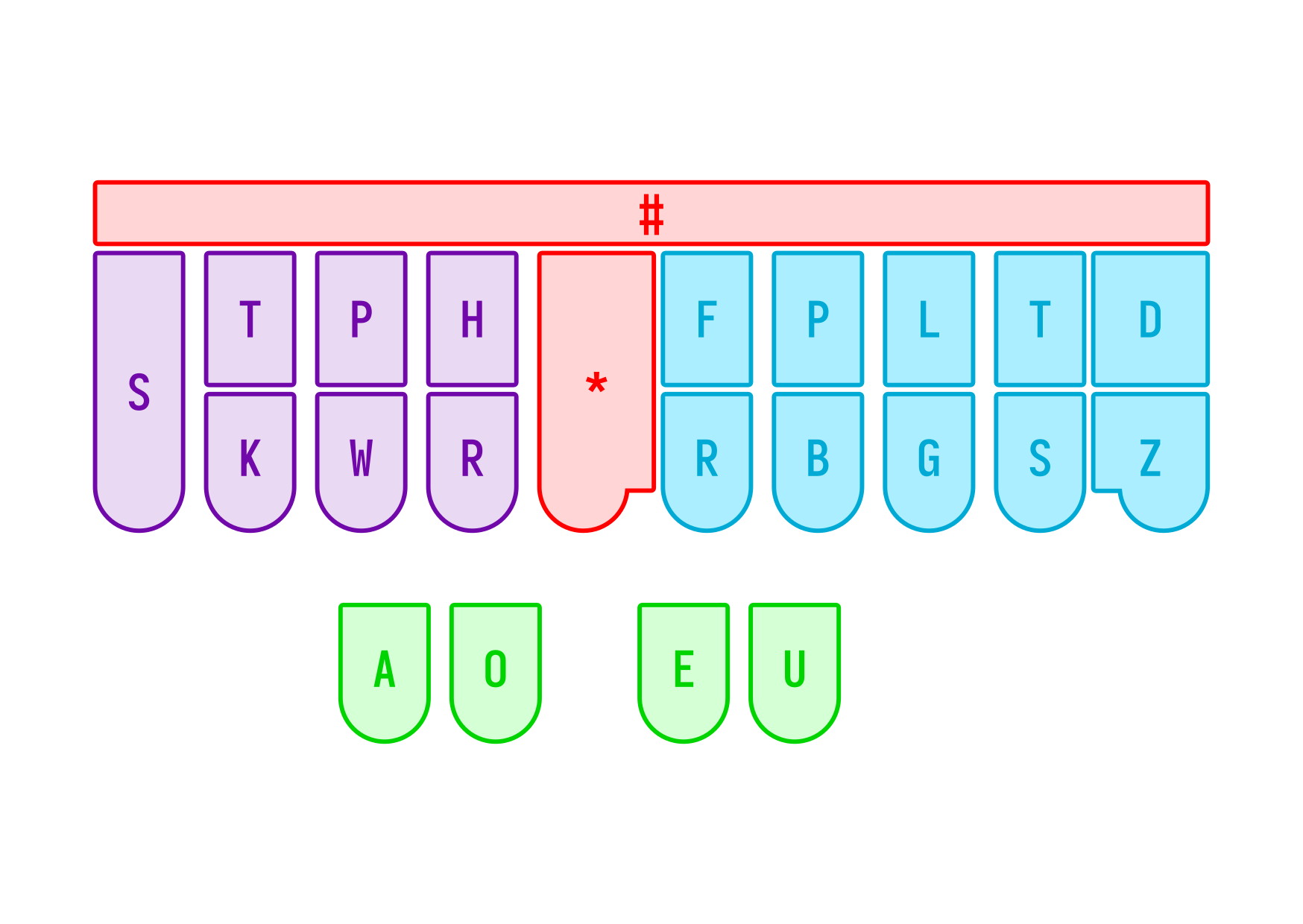
The Stenotype layout (also known as the Ireland or WSI layout) is an English-language steno layout, first developed by Ward Stone Ireland and patented in 1911. The first machines bearing this layout were produced by Ireland's Universal Stenotype Company[1], and it is now the predominant steno layout for the English language, and has also been adapted to other languages. Its steno order is:
STKPWHRAO*EUFRPBLGTSDZ
History
Patents were first issued to Ireland in 1911 for a "type-writing machine"[2] containing 19 keys and a number bar; and in 1913 for a steno theory[3] using that layout. Later versions of this layout added one or two keys in the middle, now the asterisk key, and a fifth column on the right-hand side for the -D and -Z (originally a second -S, referred to as "-S under -D") keys.
The first theory for this layout was published in the book Stenotypy in 1914; most mainstream English steno theories are ultimately derived from this theory and continue to use many chords and rules from it.
Chords
Key and chord placement
The Stenotype layout is designed such that its steno order allows for chords that follow English phonotactics (allowable sound sequences within English syllables). On their own, each key represents the sound it is labeled with. To write the word "hot", one would press HOT. Keys can be combined into chords to make up for the missing sounds not on the layout (e.g. "shot" is written as SHOT). The WSI layout allows for many of these simple combinations that match their spellings.
However, many sounds in English cannot be composed this way. Some sounds have be assigned key combinations that do not show up in English, such that there will be no ambiguity in the chord. For example, the "b" sound as in "bot" is given PW. Since "pw" is not a valid sound in English, it is safe to use this chord. All of these are also designed and placed such that they can be combined with other chords (e.g. combining PW for "b" and HR for "l" results in the "bl" consonant as in "blot").
References
- ↑ Stenograph LLC. The History of Writing Machines.
- ↑ Ireland, W.S. (1911). Type-writing machine (U.S. Patent No. 980,274).
- ↑ Ireland, W.S. (1913). Stenographic writing means. (U.S. Patent No. 1,057,964).